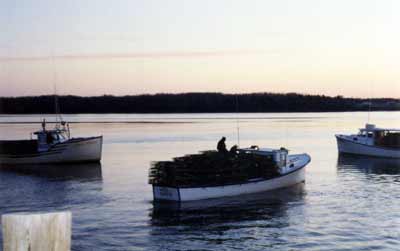
Wallace is an active fishing port. Approximately a dozen commercial fishing boats ply the waters of the Northumberland Strait from the Wallace wharf in search of lobster, crab, scallops, herring or mackerel. Other wharves in Malagash and Pugwash are also active, in use by more fishermen of the area. Many smaller vessels are used further up the estuary itself for harvesting oysters, quahogs, gaspereau, smelts and eels.
Today, of all the commercial species, lobster is by far the most important. The lobster season in our area runs through May and June. Boats rumble out the harbour before dawn six days a week with fishermen spending about twelve hours daily hauling 300 traps. Each trap is tethered to a buoy colour coded to the individual fisherman. A good day's catch is 300 lbs; but catches can range from almost none to 2,000 lbs. or more depending on the abundance of lobster that year.
A typical Wallace lobster boat is about forty feet long, with a diesel engine and forward cabin and wheelhouse, equipped to fish multi-species. A good time to see the Wallace fleet is on a sunny Sunday in May or June when the resting fishing boats are nestled around the wharf. Spending a day on a lobster boat is an unforgettable experience and can be arranged. Although some days are a little rough; (a freshening northwest gale can work up an eight foot chop in no time in the central Northumberland Strait) most of the time there is just no better place to be; awe-inspiring sunrises, an endless expanse of open sea and a sense of freedom that can't be found on land; and air so pure you can smell the lilacs in June when the breeze is right.
The thrill of fishing itself is in the suspense and surprises. Fishermen run each trap where experience guides; but they never know for sure. On a 300 lb. day over half the traps will be empty; but some might have six pounds or more. Lobster traps will also catch crab, sculpins, eels, starfish, perch and many other strange and wonderful species that are returned to the water. You just never know what might come up in a lobster trap.
Below what appears to be endless miles of sparkling sea off the shores near Wallace are the lobster fishing grounds; the Betts Ground, the Langille Ground, Church Reef, the Trenholm Shoal, Georgie, Oak Island Reef, the Seaman, the Hickie, the Mason, the Baker, Robinson Brook middle ground, the McGinnis middle ground, many of them named for fishermen from long ago.
Commercial lobster fishing began here in the late 1800's when lobster canneries sprang up along the shores enabling this tasty crustacean to be shipped to city markets. One processing facilty remains, located just to the east of the Wallace wharf, which employs many workers seasonally. Times have changed much in the lobster fishery here. Around the year 1900, small sailboats (that could be rowed when it was too calm), carried fishermen out to haul lines of 100 traps each, by hand. Starting at one end of the line, traps were hauled on one side of the boat, fished, baited and run off the other side as the boat was hauled along "under" the line of traps. It was hard work, especially if they had to row ashore at the end of the day with 1,000 lbs. of lobster. According to one old fisherman by the end of the season the muscles up and down his back were so big he couldn't get his coat on.
Wooden boats, traps and buoys have been replaced with fiberglass, steel wire and styrofoam. Sails and oars have been replaced with diesel engines. Rubber gloves and pants have replaced wool mitts and oilskins. Landmarks have been replaced with GPS plotters. Sounding irons have been replaced by video depth sounders that show a picture of the depth and type of seafloor. But the basic principle of baiting a trap and setting it down where a lobster might crawl into it remains the same. And the lobsters taste just the same as back when poor kids had to take them to school in their sandwiches while the rich kids had the privilege of eating peanut butter.